The History of Dawlish
Dawlish, that charming seaside spot in Devon, has a story that stretches back through the centuries, full of quiet villages, dramatic floods, and the kind of transformations that turn a sleepy hamlet into a holiday favourite.
Nestled between red cliffs and the English Channel, it’s the sort of place where history feels woven into the landscape, from ancient salt pans to the rumble of trains along the coast. Let’s wander through its past, starting from the earliest days and meandering up to more recent times.
The roots of Dawlish go deep into prehistory. The area’s fertile land south of Exeter drew early settlers, thanks to plentiful birds, animals, and fish. Remains in nearby Kent’s Cavern hint at human activity here long ago. Worked flints, a Neolithic stone axe from Cornwall found in the local cemetery, a stone spindle whorl for wool spinning, a Bronze Age knife, and Celtic and Roman brooches and coins turned up in fields all point to people making their mark.
The Iron Age Castle Dyke on Little Haldon, right on the parish boundary, wasn’t some fortified stronghold but more like a market and meeting place, with burial barrows nearby. The valley, sheltered by Haldon Hills with south-facing slopes and a stream to the sea, was ideal. That stream, called Doflisc in Celtic, meaning ‘dark water’, gave the town its name, evolving into Dawlish.
Early folk lived on higher ground like Haldon, venturing down as fishermen and salt makers. They’d net fish and gather salt from rock pools, but to ramp up production, they built salterns, those clay huts with smoke holes in the roof. Fires boiled brine in clay troughs to leave salt crystals. Interestingly, they didn’t use seawater straight; instead, fresh water passed over salt-rich sand from under the sea, packed into troughs.
The fine salt went into storage sheds. Dawlish made less than neighbour Teignmouth, perhaps because of the tricky Dawlish Water, prone to flooding that could sweep things out to sea. No people recorded lost that way, but in the early 1800s, two ponies were.
Salt making started before Roman times, around 55 BC, and lasted until the Romans left in 400 AD. In the Anglo-Saxon era, from 400 to 1000 AD, it stopped in Dawlish while Teignmouth kept going. Population grew, with settlements in the upper valley where floods were rarer and soil richer. Farms popped up at Aller, Smallacombe, Lidwell, Higher and Lower Southwood.
Romans invaded Britain in 55 BC, but Celts in Devon and Cornwall stayed mostly undisturbed until Anglo-Saxons arrived. Those newcomers traded more than conquered, mixing with locals, so today’s descendants are a blend. Danes raided around 800 AD, but Dawlish escaped, maybe due to shallow waters and marshy land offering slim pickings. Nearby Bishopsteignton got torched in 1001, along with spots at the Teign’s mouth. No Roman visits confirmed, despite their base in Exeter and a bridge over the Teign.
Fast forward to 1044, when Edward the Confessor, last Anglo-Saxon king, granted an estate at Dawlish to his chaplain Leofric. Raised in Lorraine, Leofric met the exiled Edward in 1041, returned with him, and became Bishop of Devon and Cornwall, moving the see to Exeter in 1050. He kept the estate until 1072, then left it to the church.
This might have been part of a bigger Anglo-Saxon royal holding between Exe and Teign; Alfred the Great willed land at Exminster to his son in 899. Teignton burnt by Vikings in 1001 was probably Kingsteignton. These lands could link back to British kings of Dumnonia when Wessex held Devon east of Dartmoor. After the Norman Conquest, Leofric gave it to Exeter Diocese, which held it until 1802. Dawlish’s coat of arms nods to this, with Edward’s elements on the left, Leofric’s on the right, and Exeter’s crossed keys below.
Medieval life rolled on after 1066 with little change at first; taxes stayed the same. The Domesday Book of 1086 listed Dawlish under Bishop Osbern, with tax on seven manors, 30 villagers, eight smallholders, meadows, pasture, woods, livestock, worth a fair sum. The bishop held a chunk becoming the Barton estate, with slaves noted. Taxes rose, land cleared for farms. Names like Southwood might date to Saxon times. By 1253, Exeter Cathedral’s Dean and Chapter ran Dawlish, picking local reeves yearly, like Richard Mugge in 1388 or John Shylston in 1443, names that lingered.
A wooden Saxon church likely stood before St Gregory’s, built inland from tides and marshes. Earliest mention in 1148, when it supported canons. A Norman corbel suggests an earlier stone one. First vicar in 1272; by 1282, it mothered St Michael’s in East Teignmouth and St Mary’s in Cofton. A Saxon cross survives outside.
The Black Death hit hard between 1346 and 1349, killing three vicars and likely half the folk, like Devon’s 48% rate. Survivors bargained better wages, helping end feudalism. By 1438, a red sandstone tower rose at St Gregory’s, with bells by 1588, including a great one for funerals, and an early clock. The church, possibly cob originally, was rebuilt in 1825 after dilapidation.
In the 13th century, Lidwell Chapel on Haldon, dedicated to St Mary, saw dark deeds; in 1329, hermit Robert de Middlecote robbed travellers and got executed. Dawlish and Teignmouth split paths: flat beaches offered no ship shelter, unlike Teignmouth’s harbour. Yet both built ships for Scotland wars, showing wealth. For four centuries, Dawlish faded from records, owned by Exeter, amid Dark Ages poverty and plagues.
Tudor times brought prosperity. Taxes funded wars, announced in church. The 1548 Protestant shift under Henry VIII passed quietly, but a monastery pensioner served locally. The 1549 Prayer Book Rebellion stirred the West Country. Men trained for the Armada; wealthy provided arms for archers, gunners, more. In 1588, churchwardens noted candles for Elizabeth’s accession rejoicing, bell repairs.
Four men watched escaped Spanish prisoners. Bells rang for services, weddings, victories, even to scare lightning. Repairs included stocks, pillory, cucking stool; one woman whipped for misdemeanours. Church shored up with posts; a tree held the roof once.
The 17th century saw 360 males over 16 in 1641 Protestation Returns, all Royalists, population around 800. Some served in armies. Royalist Thomas Tripe’s house had ceilings depicting the king in an oak tree. Two soldiers buried after Powderham siege in 1645. Sir Peter Balle leased the manor, lived at Mamhead; descendants built an obelisk in 1743 for shipping. Later, Bishop Stephen Weston leased it, passing to family.
The 18th century linked to far places. Admiral John Schank at Barton House hosted Lieutenant James Grant, who took seeds from gardener Peter Churchill to Australia, planting on what became Churchill Island. Fishing was secondary to farming; tithes declined. Many sailors, though no harbour: 1619 listed master mariners, sailors, seinemen.
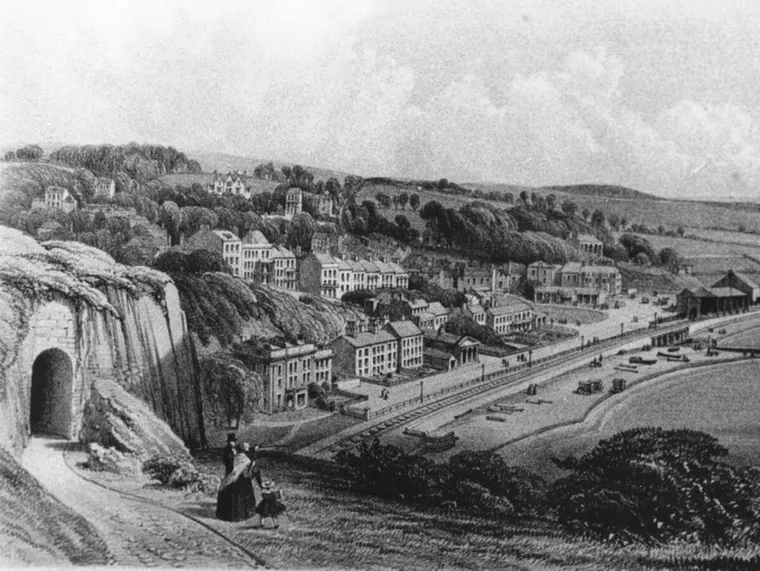
Napoleonic Wars brought naval folk to Torbay, building houses for officers and wealthy visitors barred from Europe. Tourism sparked: Strand hotels in 1780s; locals in cob cottages. Industrial Revolution hit with Brunswick Mill in 1717, rebuilt 1825, running till 1959. Town Mill in Church Street, another near Ashcombe.
Population about 1000, shifting from insularity to popularity under George III, who touted sea bathing and air. Aristocrats built Georgian villas on Park Road and High Street, unimpressed by old cottages. Bathing mostly for men; huts for them only, aiding hygiene. Dawlish grew fashionable in the 19th century, featured in Dickens and Austen novels.
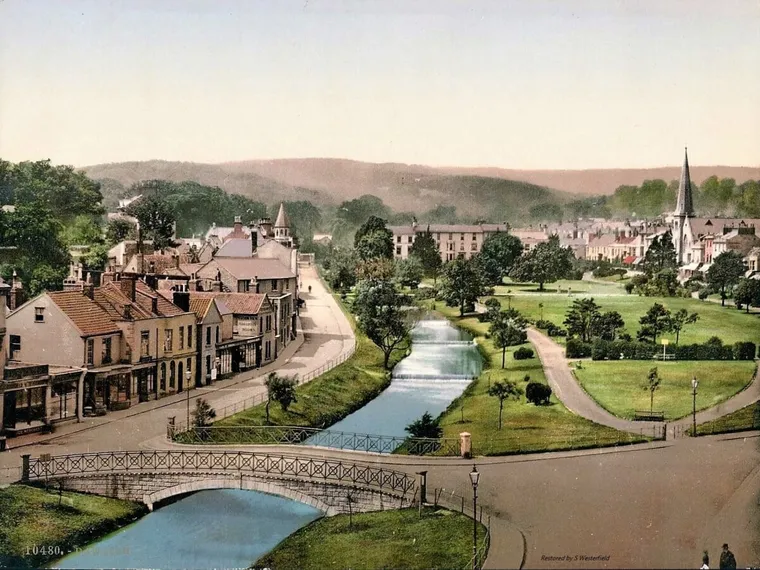
In 1802, Exeter sold the manor to Richard Eales, then divided among wealthy buyers; 291 houses, 1424 people. Jane Austen visited. John Manning landscaped in 1803, draining marshes, straightening the Brook for building. But 1810 floods after rain wrecked lawns, bridges, houses, costing dearly.
Weirs added to prevent repeats; Brook unchanged since, later with waterfowl. Buyers like Hoares built Luscombe Castle, Stonelands by Nash. Others erected Lanherne, Elm Grove, Plantation House. High Sheriffs lived there. The Rise hosted Princess Caroline in 1806.
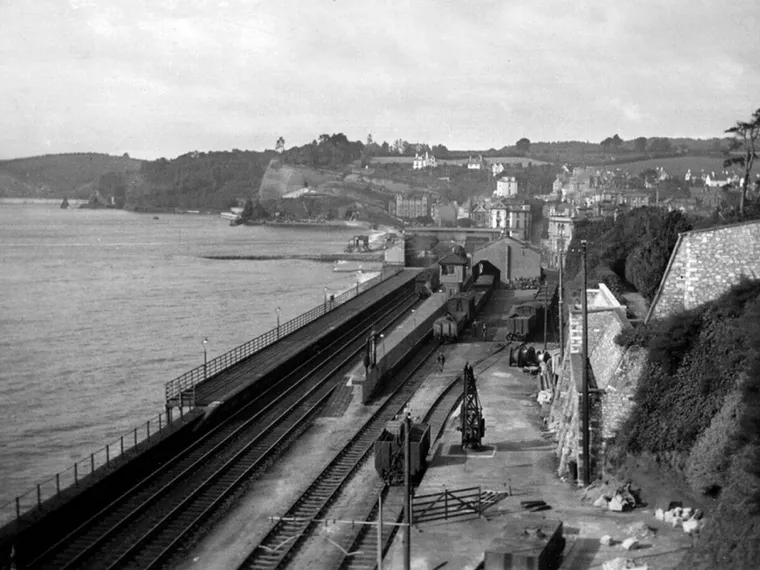
The railway transformed everything. In 1830, Brunel planned an atmospheric system: pneumatic tube with vacuum ahead, pressure behind. Patent model worked, but 1844 full-size failed, converted to conventional. Navvies built line and tunnels, boosting economy, especially pubs.
First train 30 May 1846 to Exeter, making Dawlish first resort with rail. Single to double track later. It’s scenic, in and out of cliff tunnels, costliest to maintain due to sea. Population grew; outsiders outnumbered locals. Farms gave way to houses; cider, lace, brewery till 1925 supplied pubs. Violets sent to London.
The 20th century saw black swans from a New Zealander in 1906, linked to John Nash who emigrated but returned. Railway growth, shorter trips, paid holidays swelled holidaymakers. Day trips replaced upper-class stays; villas became hotels. Population from 3000 to 12000. Dawlish Warren station 1905 boosted numbers; by 1930, low-budget resort with camps, chalets, caravans.
Trains packed in summer. In 1953, for Elizabeth II’s coronation, motto ‘Pratum Juxta Ribos Aquarum’ – meadowland by running waters. Emblem mixes Confessor, Leofric, Exeter arms. From 1970s, foreign holidays cut visitors; hotels turned flats or homes. Tourism still key, with arcades, camps, shops. Population around 13000 by 2011. Farms declined, shopping changed streets, but beaches, carnival, black swans endure.
Dawlish’s tale is one of resilience, from ancient salt makers dodging floods to Victorians riding atmospheric dreams that fizzled. It’s a town shaped by sea, cliffs, and visitors seeking its gentle charms. Even today, walking the Brook or gazing at red rocks, you feel echoes of those early Celts and Georgian bathers. What started as dark water became a bright spot on Devon’s coast.
Read More
- Dawlish – greatcliff.co.uk
- The Atmospheric Road – columbia.edu
- Dawlish Beaches 1770-2020 – dawlishhistory.org.uk
- On the Early History of Dawlish – genuki.org.uk