The South Devon Railway Sea Wall at Dawlish
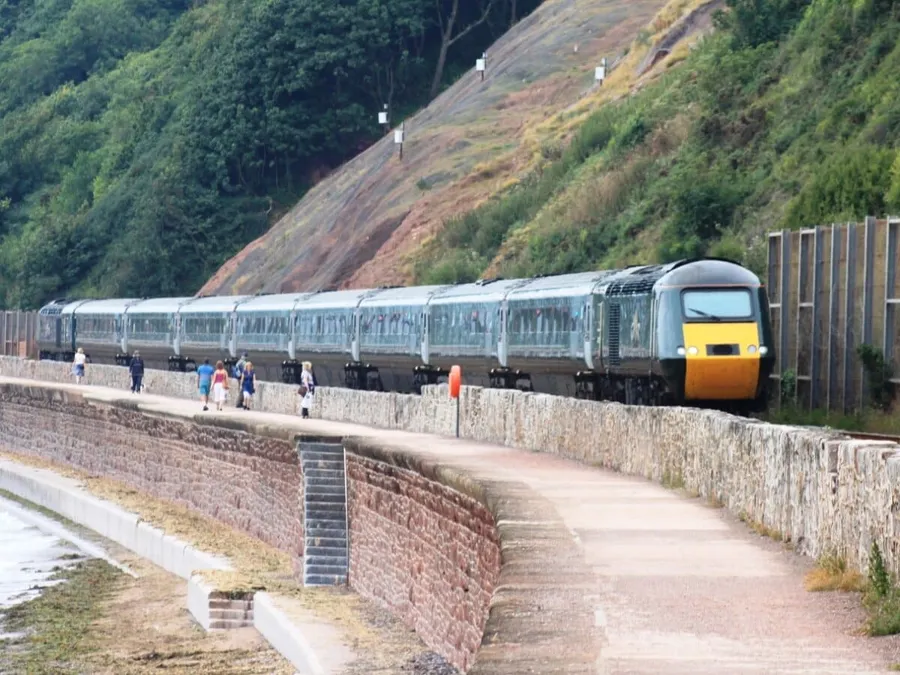
The railway slices through Dawlish like a ribbon pinned against the relentless pull of the English Channel. Built in the 1840s under Isambard Kingdom Brunel’s direction, this stretch of the South Devon Railway hugs the shoreline from Dawlish Warren to Teignmouth, a precarious ledge of granite and ambition.
Brunel, ever the innovator, envisioned an atmospheric system here, where piston-powered vacuum tubes would propel trains without smoke or steam. Pumping stations dotted the line, including one at Dawlish, but the experiment faltered after a year, plagued by leaks and seals that could not hold back the damp Devon air. By 1848, conventional locomotives took over, and the broad-gauge tracks carried passengers onward to Plymouth.
That granite sea wall, though, remains the star. Stretching over four miles directly exposed to the open sea, it cradles two tracks between crimson cliffs and crashing waves. Southbound trains skim the water’s edge, while northbound ones press against the rock face. Tunnels pierce the landscape: Kennaway’s dark bore emerges onto Shell Cove beach, where black tarry seaweed clings to boulders.
Further on, Parson and Clerk Rocks jut from the surf like petrified sentinels, named for a drowned clergyman and his clerk in a 19th-century shipwreck. The wall itself, rebuilt countless times, bears the scars of its battles. In 1852, a rockfall at Breeches Rock halted services for days; passengers transferred by horse-drawn cart along the beach below. The winter of 1872-73 brought breaches totalling over 200 yards near Rockstone, forcing single-line working and bus shuttles.
Storms have tested it relentlessly. The tempest of 4 February 2014 tore a 60-metre gap at Riviera Terrace, leaving rails dangling like frayed threads over the void. The South West peninsula, home to 1.7 million people, lost its rail lifeline for two months. Network Rail marshalled 300 workers, pouring 6,000 tonnes of concrete and 150 tonnes of steel to mend it in record time.
Resilience followed: a £165 million programme raised the wall by 2.5 metres south of Dawlish station and added a rockfall shelter at Parson’s Tunnel, completed in 2023. Yet funding gaps persist for cliff stabilisation between the tunnel and Teignmouth, with costs now estimated at £80 million amid rising sea levels.
For those on foot, the path alongside forms part of the South West Coast Path, a pedestrian ribbon tracing the wall’s edge. From Dawlish station, steps lead down to the promenade, where black swans glide in the brook that meets the sea. Walkers share the space with trains thundering past, their horns a brief salute.
The route demands respect: steep inclines at Smugglers Lane give way to level stretches past Coryton Cove, but high tides and gales can close it abruptly. In calmer hours, it rewards with sightings of seals basking on ledges or gulls wheeling over the foam.
This engineering relic doubles as a commuter artery and tourist draw. Great Western Railway services rattle through hourly, linking Exeter to Paignton, while freight hauls aggregates under cover of night. Photographers flock to the wall’s vantage points, cameras primed for the spray-laced drama of a HST slicing through the swell.
The line’s survival underscores Devon’s coastal fragility, a reminder that progress here means constant vigilance against the tide.
Read more
- Sea Wall History – dawlishtrains.com
- The Atmospheric Railway – exetermemories.co.uk
- South Devon Railway – gracesguide.co.uk
- Dawlish Sea Wall – networkrail.co.uk
- Dawlish railway: Decade on from storm devastation – bbc.co.uk
- The Sea Wall Route and Photographic Viewpoints – dawlishtrains.com